
English


Views: 0 Author: Site Editor Publish Time: 2026-11-10 Origin: Site


When evaluating air filtration systems, procurement teams often default to a single, familiar metric. You will frequently see technical data sheets highlighting the activated carbon iodine value as the ultimate proof of quality. But relying on this one number can be a serious operational mistake. Industry professionals often treat this single-point laboratory test as a universal proxy for real-world air purification performance. This oversimplification ignores the complex dynamics of gas-phase filtration.
Different pollutants require different pore structures, which a basic iodine test simply cannot measure. The iodine value is a necessary indicator of surface area. However, it remains insufficient and potentially misleading when you evaluate activated carbon for specific vapor-phase contaminants. In this article, we will explore why you need a more comprehensive approach to media selection. You will learn how to match carbon morphology to your exact filtration needs for optimal performance and operational reliability.
Iodine Number Defined: Represents micro-pore surface area; an excellent indicator of small-molecule adsorption potential.
The "One-Number" Trap: Why relying solely on high iodine value can lead to suboptimal carbon selection and higher operational costs.
Missing Variables: Why CTC (Carbon Tetrachloride) values and MB (Methylene Blue) values are critical for identifying medium-to-large pore distribution.
Application-First Strategy: Matching carbon morphology to the specific molecular size and concentration of target VOCs.
Performance Verification: The shift from generic lab-bench specs to pilot-scale testing and breakthrough curve analysis.
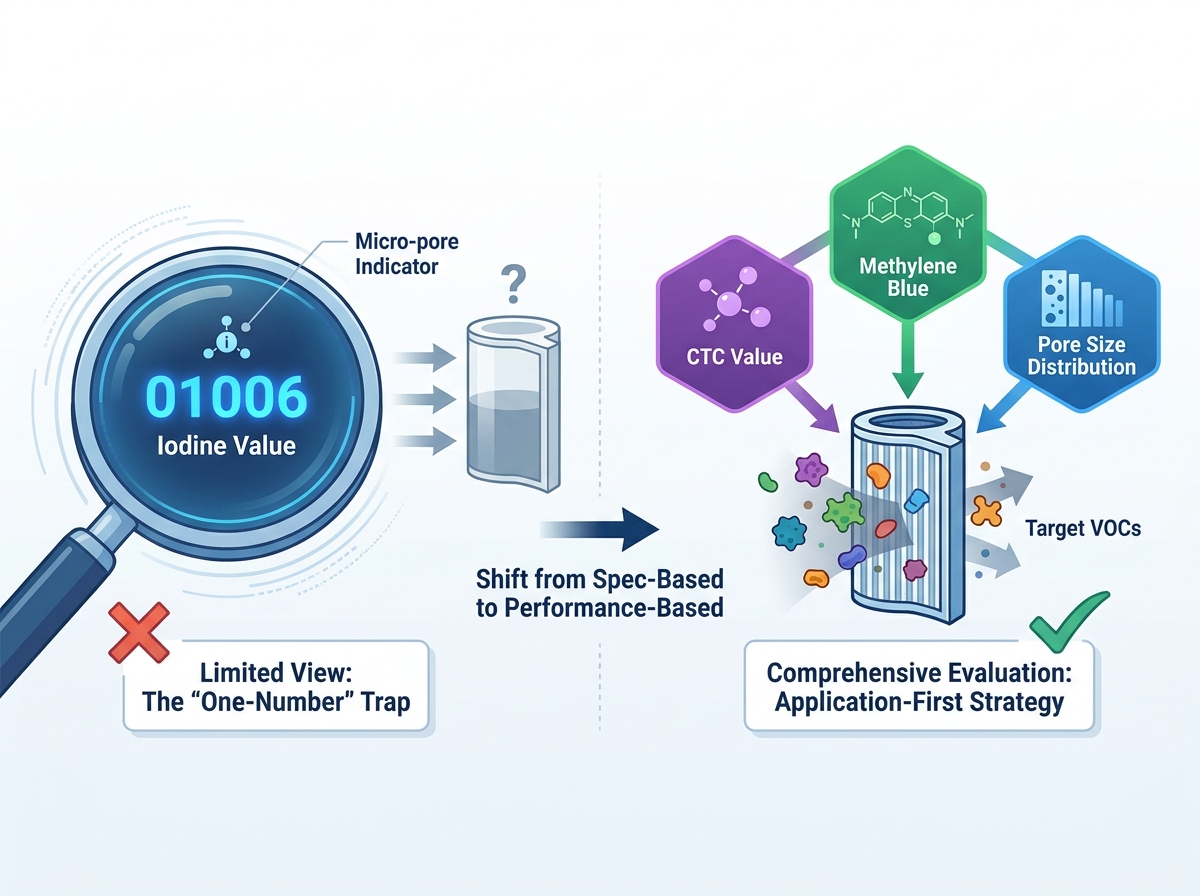
To understand the limitations of current procurement habits, we must first look at the technical scope of the standard iodine test. Formalized under ASTM D4607, this laboratory procedure measures the amount of iodine adsorbed from an aqueous solution by one gram of activated carbon. The final result gives us the iodine number, typically expressed in milligrams per gram (mg/g). Engineers generally accept this metric as a reliable, baseline estimate of the carbon's total internal surface area.
However, the underlying physics of this test reveal a major blind spot for air filtration applications. Iodine molecules are incredibly small, measuring around 0.33 nanometers. Because of their size, they easily penetrate and measure the micro-pores. According to the IUPAC classification, micro-pores are cavities smaller than two nanometers in diameter. If you want to capture tiny gas molecules, highly developed micro-pores are exactly what you need. But real-world industrial emissions and commercial air streams rarely consist entirely of tiny molecules.
This dynamic introduces a critical limitation in media evaluation. Exceptionally high iodine counts can easily coexist with terrible removal efficiency for medium-chain or large-molecule volatile organic compounds (VOCs). Consider a scenario where you must capture large hydrocarbon molecules. If you deploy a carbon media optimized only for micro-pores, the large VOCs will instantly block the outer entrances of the pore structure. They simply cannot fit inside the deep micro-pore channels. This bottleneck phenomenon leaves the vast majority of the internal surface area completely unused.
Choosing a high-iodine carbon for the wrong gas stream introduces significant operational risk. You will experience premature media saturation much earlier than the data sheet suggests. Consequently, the filtration system will require frequent bed changes. This causes unexpected downtime, disrupts facility operations, and forces maintenance teams into reactive troubleshooting. The carbon might boast an impressive laboratory specification, but it will fail entirely in your specific vapor-phase application.
If iodine cannot tell the whole story, we need other indicators to evaluate the medium-to-large pore distribution. This is where CTC and Methylene Blue (MB) values become essential tools for filtration engineers.
The CTC (Carbon Tetrachloride) value measures the capacity of the carbon to adsorb carbon tetrachloride vapor. Unlike the liquid-phase iodine test, the CTC test specifically evaluates gas-phase adsorption. Because the CTC molecule is structurally larger than iodine, it acts as a much more reliable predictor for standard gas-phase VOC adsorption capacity. It gives you a realistic, practical picture of how the carbon bed will handle typical airborne solvents, industrial off-gases, and common airborne pollutants.
For even larger target molecules, we look at the Methylene Blue (MB) value. This test determines the carbon's ability to decolorize a methylene blue dye solution. Methylene blue molecules are relatively large and bulky. They primarily adsorb into the meso-pores, which range from two to fifty nanometers in diameter. Identifying macro-porosity and meso-porosity is crucial when you treat complex, multi-component gas streams. If your industrial exhaust contains heavy hydrocarbons, complex odorous compounds, or large solvent molecules, a carbon with a high MB value is mandatory for success.
Table 1: Comparative Matrix of Carbon Adsorption Indicators
| Indicator Test | Testing Phase | Primary Pore Focus | Best Used For |
|---|---|---|---|
| Iodine Number | Liquid | Micro-pores (<2 nm) | Small molecule gases, basic low-weight odors |
| CTC Value | Gas | Micro to Meso-pores | General VOCs, standard industrial solvents |
| Methylene Blue | Liquid | Meso-pores (2-50 nm) | Large molecules, complex heavy hydrocarbons |
This comparative matrix highlights an evidence-based caution for air filtration engineering. In the world of adsorption kinetics, more is not always better. A carbon rating of 1200 mg/g iodine might perform significantly worse than an 800 mg/g iodine carbon if the latter possesses the correct meso-pore structure for your specific target contaminant. Aligning the pore structure with the pollutant is always more important than maximizing a single specification.
Selecting the right media requires a systematic, application-first strategy. You must move beyond generic manufacturer numbers and rigorously analyze your specific operating conditions. By following a structured matching process, you ensure optimal filtration efficiency.
Step 1: Identifying your target contaminants. You must define the molecular weight, polarity, and concentration of your target VOCs. Small, non-polar molecules require tight micro-pores to create strong van der Waals forces. Heavier, complex molecules like styrene or xylene demand a highly developed meso-pore network. High influent concentrations might also dictate a different carbon density to prevent rapid breakthrough and ensure adequate contact time.
Step 2: Defining the operational environment. Activated carbon does not operate in a vacuum. You must strictly account for relative humidity, flow rate, and airflow temperature. High relative humidity causes capillary condensation, where water vapor turns to liquid inside the pores. This water competes directly with VOCs for valuable adsorption sites, drastically lowering capacity. Similarly, higher temperatures reduce overall adsorption efficiency because physical adsorption is an exothermic process.
Step 3: Evaluating physical properties. You must look past the standard adsorption metrics to evaluate the physical datasheet. Hardness, tested via ASTM D3802, is absolutely critical. Soft carbon degrades quickly in high-velocity airflows. This degradation creates fine dust that can damage downstream HEPA filters or delicate mechanical equipment. Ash content indicates inorganic impurities, which can sometimes catalyze unwanted chemical reactions in the filter bed. Finally, apparent density affects exactly how much carbon mass you can physically fit inside your filter vessel.
Filtration Environment Impact Chart
| Environmental Variable | Optimal Operational Range | Impact on Adsorption Efficiency |
|---|---|---|
| Relative Humidity (RH) | Below 50% | High RH leads to water vapor condensing in pores, outcompeting VOCs for active sites. |
| Airflow Temperature | Below 40°C (104°F) | Adsorption is exothermic. Higher ambient temperatures cause trapped gases to release. |
| Residence Time | > 0.1 seconds | Airflow that moves too fast prevents gas molecules from diffusing into deep pore structures. |
Finally, consider your compliance requirements and the manufacturer's activation methods. The chosen activation method significantly influences the final performance beyond the iodine number. High-temperature steam activation generally creates a well-balanced pore structure suitable for most standard air filtration tasks. Chemical activation, often using phosphoric acid, tends to create much larger meso-pores. Knowing exactly how the manufacturer activated the carbon helps you predict its real-world behavior and ensures compliance with environmental discharge limits.
The procurement phase is where many promising air filtration projects go wrong. Buyers often struggle to interpret supplier data sheets without getting blinded by exceptionally high iodine numbers. You must approach these technical documents critically and ask the right questions.
The primary danger during procurement is "specification inflation." Suppliers know that buyers actively look for high iodine values. To win bids, manufacturers will aggressively activate the carbon to maximize this specific metric. However, extreme over-activation can literally burn away the internal carbon walls. It creates an extremely porous but highly fragile material. You end up purchasing a product that tests brilliantly in a laboratory setting but quickly crumbles into useless dust inside your industrial air handler.
Standardized lab tests are not real-world simulations. To ensure project success, integrate these best practices into your procurement lifecycle:
Request bed-life estimations: Ask the supplier to mathematically model expected performance based on your specific influent concentrations and airflow rates. Predictive tools like the Wheeler-Jonas model provide much better performance insights than a raw, static datasheet.
Analyze the full pore size distribution: Request the specific laboratory data for micro, meso, and macro-pore volumes. Do not accept a single surface area metric as proof of capability.
Demand pilot-scale testing: For critical or large-scale air purification systems, bench-scale numbers remain insufficient. Run a small-scale pilot test using a slipstream of your actual exhaust gas to monitor the true breakthrough curve over time.
Seek third-party analytical validation: If your application involves strict environmental regulatory compliance, rely on independent laboratory verification of the spent carbon capacity before committing to bulk purchases.
Transitioning your strategy from reading data sheet specs to demanding pilot validation guarantees you select a carbon genuinely tailored to your facility. It eliminates the guesswork, prevents specification inflation from ruining your design, and protects your ventilation system from premature failure.
The industrial filtration sector is slowly but surely shifting from "spec-based purchasing" to "performance-based selection." Procurement teams and plant engineers now realize they must look at the whole picture to maintain clean air. While the iodine value provides a helpful baseline for total surface area, it only serves as a broad filter for the carbon category. It is never a guarantee of solution fit for complex gas streams.
To achieve highly efficient air purification, you must align your technical requirements with specific VOC molecular characteristics. Stop chasing the absolute highest numerical value on a supplier's datasheet. Instead, evaluate the CTC value, critically analyze the meso-pore structure, and rigorously account for your operating humidity and temperature. By matching the carbon's exact morphology to your target pollutants, you ensure longer bed life, reduce maintenance interventions, and achieve highly reliable air quality control.
A: No. A higher iodine value only indicates a greater potential in the micro-pore structure. While this is excellent for capturing very small molecules, it is largely irrelevant for large-molecule VOCs. If your target pollutants are large, a high-iodine carbon might saturate almost instantly on its outer surface.
A: The iodine test is a liquid-phase indicator that measures micro-porosity. The CTC (Carbon Tetrachloride) test is a gas-phase performance simulation that measures the carbon's capacity to adsorb organic vapors. For air filtration, CTC generally provides a more accurate prediction of how the media will handle airborne VOCs.
A: You should implement a routine monitoring schedule to check for VOC breakthrough rather than relying solely on the "expected life" from a datasheet. Testing frequency depends on your pollutant load, but checking the exhaust air monthly or quarterly ensures you catch saturation before it causes compliance issues.
A: When relative humidity exceeds 50%, water vapor begins to condense inside the carbon pores through capillary action. This liquid water physically blocks the pores and aggressively competes with VOCs for adsorption sites. Even carbon with a massive surface area will fail if water occupies the active sites first.
A: You should immediately ask them for the full pore size distribution report. Additionally, request the CTC value (or Butane Activity), the Methylene Blue value, and the particle size distribution. These metrics will give you a complete picture of the carbon's ability to handle your specific gas stream.


