
English


Views: 0 Author: Site Editor Publish Time: 2026-10-15 Origin: Site


Industrial and commercial filtration systems face a constant engineering challenge. You must maximize contaminant adsorption and removal efficiency while keeping system pressure drop and energy consumption low. Selecting the wrong carbon morphology leads to severe operational inefficiencies. Forcing air or water through excessively dense beds creates high energy demands on pumps and blowers. Conversely, improper contact time causes premature filter exhaustion or allows contaminant bypass. This directly compromises purification standards and regulatory compliance.
Evaluating honeycomb activated carbon vs granular carbon requires looking far beyond baseline adsorption capacity. The decision hinges entirely on flow dynamics, contact time requirements, and trace contaminant removal efficiency. Engineers must balance the physical geometry of the carbon against the specific fluid or gas dynamics of their system. This ensures optimal performance and long-term reliability without overloading mechanical infrastructure.
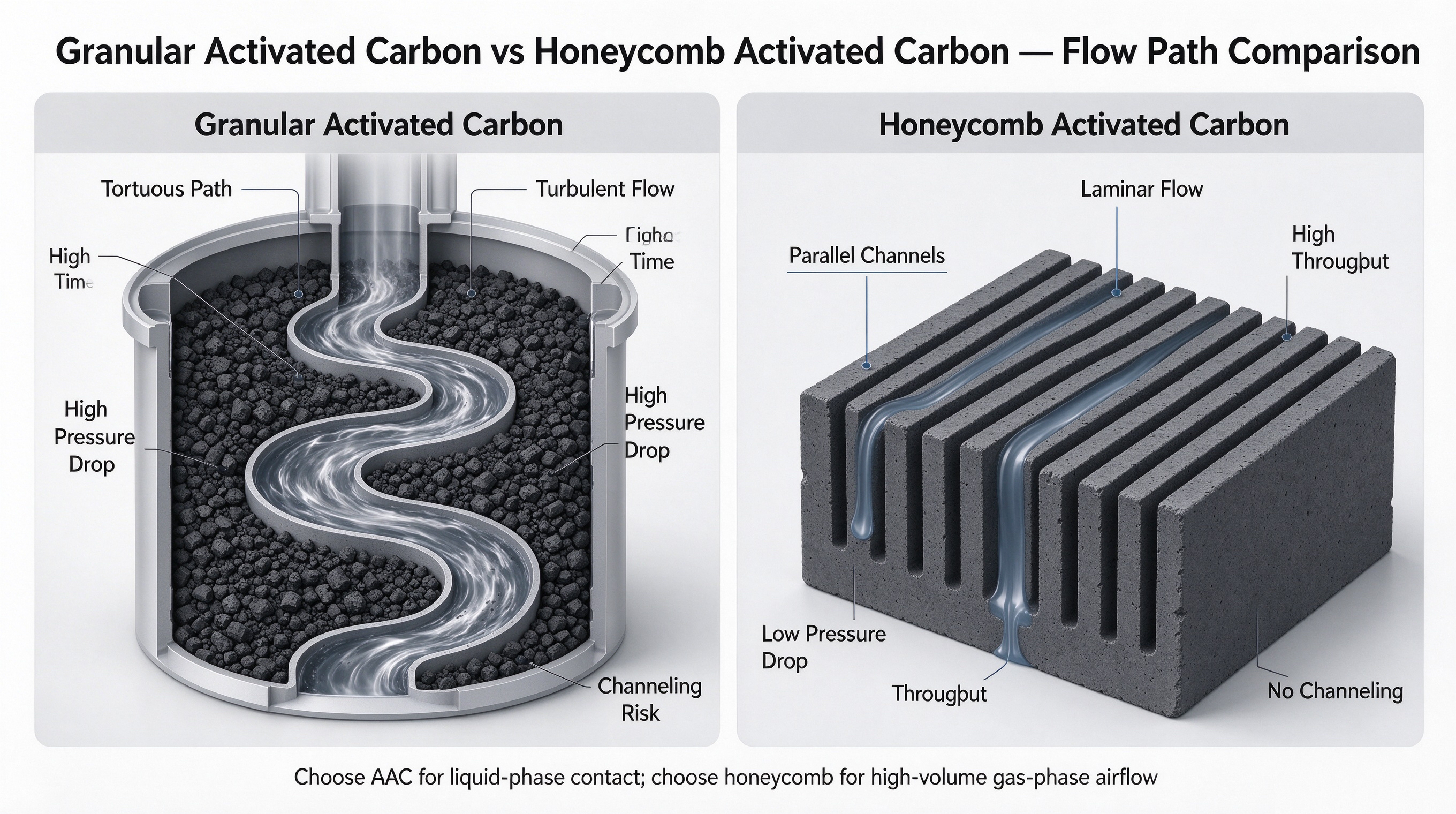
Flow Dynamics & Pressure Drop: Honeycomb activated carbon filters drastically reduce aerodynamic and hydrodynamic resistance compared to granular beds, making them superior for high-volume flow applications.
Adsorption Efficiency vs. Channeling: Granular carbon offers high density and surface area but is prone to channeling and bypass over time; honeycomb structures ensure uniform flow distribution and a higher consistent contaminant removal ratio.
Application Specificity: Granular carbon remains the standard for general liquid-phase filtration, point-of-use applications, and low-flow systems, whereas honeycomb carbon is the industry standard for high-volume gas-phase filtration (e.g., VOC removal, industrial exhaust).
Cost Implications: While granular carbon has a lower initial procurement cost, honeycomb filters often yield lower long-term operational expenses in high-flow systems due to reduced fan/pump energy requirements.
Activated carbon filtration performance depends on pore structure, adsorption capacity, contact time, flow rate, and filter design. Granular activated carbon (GAC) and honeycomb activated carbon have different physical structures, affecting how air or water moves through the filter.
Selecting the right material requires evaluating both adsorption performance and operating conditions rather than relying only on surface area or iodine value.
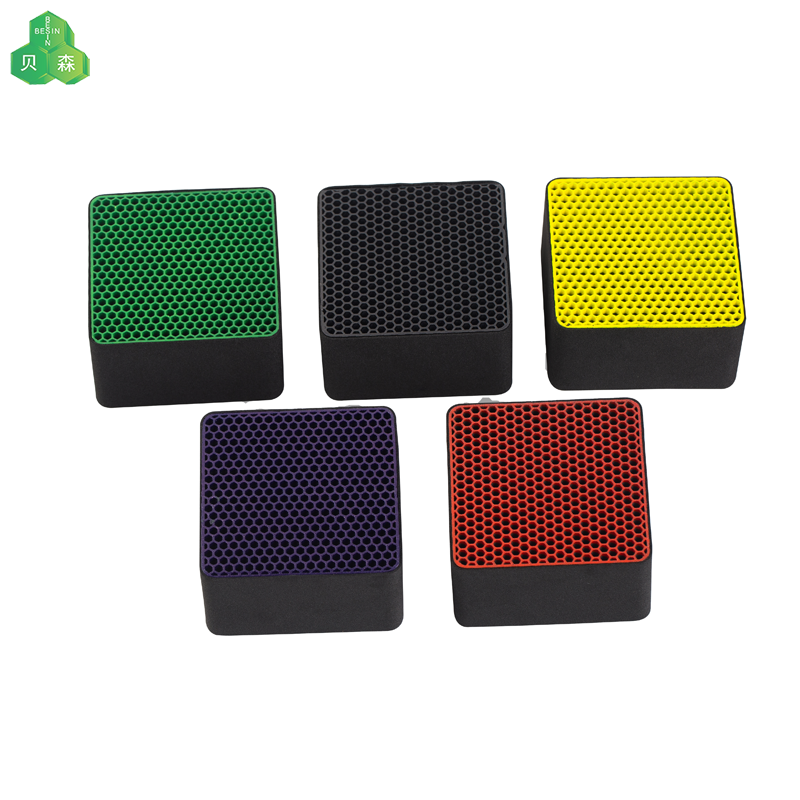
Honeycomb activated carbon contains parallel channels designed to allow air to flow through the filter with relatively low resistance.
Solid carbon block filters typically use compressed carbon particles to form a dense filtration medium, commonly used in water purification systems.
Although both are structured carbon materials, they differ in flow paths, pressure requirements, and typical applications.
Granular activated carbon consists of loose carbon particles packed into a filter bed. Water or gas flows through the spaces between the granules, allowing contaminants to reach the carbon's porous surface.
GAC is widely used in water treatment and can also support gas adsorption applications. Its performance depends on particle size, bed depth, flow rate, and contaminant characteristics.
Honeycomb activated carbon filters feature straight, parallel channels that allow air to pass through while gaseous contaminants adsorb onto the porous carbon surfaces.
This structured design can reduce airflow resistance compared with certain granular packed beds, making honeycomb carbon suitable for industrial air purification, VOC removal, and odor control.
Explore our Honeycomb Activated Carbon Filters for industrial air filtration applications.
When comparing GAC and honeycomb activated carbon, engineers should evaluate pressure drop, contact time, adsorption efficiency, and flow distribution.
Pressure drop affects the energy needed to move air or water through an activated carbon filter.
GAC packed beds can create higher flow resistance depending on particle size, bed depth, and operating velocity.
Honeycomb filters generally offer lower resistance to airflow through their parallel channels. However, actual energy savings depend on the complete system design and operating conditions.
Contact time is important because contaminants need sufficient exposure to activated carbon surfaces for adsorption.
Higher flow rates can reduce contact time and affect contaminant removal efficiency. Both GAC and honeycomb systems must be sized according to contaminant concentration, adsorption characteristics, and required treatment performance.
For packed beds, empty bed contact time (EBCT) can be estimated as:

EBCT is a useful preliminary design parameter, but it does not directly represent actual molecular contact time or guarantee removal efficiency.
Channeling occurs when fluid follows preferential flow paths through a filter, reducing effective contact with the adsorbent.
GAC beds may experience channeling due to uneven packing, settling, or flow distribution.
Honeycomb filters avoid loose-particle settling within their fixed channels, but poor installation, gaps around the blocks, or uneven inlet airflow can still cause bypass and reduce treatment efficiency.
Evaluation Factor | Granular Activated Carbon | Honeycomb Activated Carbon |
|---|---|---|
Physical Structure | Loose packed granules | Fixed parallel channels |
Typical Applications | Water treatment and gas adsorption | Industrial air purification and VOC control |
Flow Resistance | Depends on particle size and bed depth | Generally lower in comparable gas-flow configurations |
Contact Time | Controlled by bed volume and flow | Controlled by channel length, geometry, and flow |
Flow Distribution | May be affected by uneven packing | Requires proper sealing and inlet distribution |
Main Advantage | Flexible adsorption bed design | Structured airflow and compact modular design |
Granular activated carbon (GAC) and honeycomb activated carbon are both effective adsorption materials, but their structures suit different filtration requirements.
GAC is widely used in water treatment and packed-bed adsorption systems, while honeycomb carbon is particularly suitable for air purification applications requiring controlled airflow and compact filter designs.
Granular activated carbon filters are commonly used in:
Municipal Water Treatment: Removing chlorine, organic compounds, and selected contaminants.
Groundwater Remediation: Adsorbing certain pollutants, including PFAS where the carbon and system are appropriately specified.
Industrial Wastewater Treatment: Reducing dissolved organic contaminants.
Point-of-Use Water Filters: Improving water quality through suitable adsorption media.
GAC can also be used in gas-phase filtration. Its suitability depends on bed depth, contact time, contaminant concentration, and operating conditions.
Honeycomb activated carbon filters feature parallel channels that support airflow while providing surfaces for gas adsorption.
Common applications include:
Commercial HVAC Systems: Removing odors and selected gaseous pollutants.
Industrial VOC Removal: Treating certain emissions from painting, printing, and manufacturing.
Air Purification Equipment: Reducing VOCs and unwanted odors.
Industrial Exhaust Treatment: Supporting gas purification where pressure drop and airflow are important.
For HVAC applications, explore our Custom VOCs Removal Activated Carbon Honeycomb Filter.
Activated carbon filter performance depends on adsorption capacity, airflow resistance, system configuration, and maintenance requirements.
GAC packed beds can create significant pressure drop depending on particle size, bed depth, and flow rate.
Honeycomb activated carbon generally offers lower airflow resistance because of its structured channels, making it attractive for high-volume ventilation systems.
However, actual energy consumption should be evaluated using the complete filter system's pressure-drop and airflow specifications.
GAC filters may require bulk carbon removal, refilling, and flushing, depending on the vessel design.
Honeycomb carbon filters are often installed as blocks or modules, allowing straightforward replacement in compatible filter housings.
Replacement frequency depends on contaminant loading, adsorption capacity, humidity, and operating time.
Evaluation Factor | Granular Activated Carbon | Honeycomb Activated Carbon |
|---|---|---|
Structure | Loose carbon granules | Structured channels |
Typical Applications | Water treatment, packed-bed gas adsorption | Air purification, VOC and odor removal |
Pressure Drop | Depends on particle size and bed depth | Generally lower in suitable airflow systems |
Maintenance | Media replacement or refilling | Block or module replacement |
Dust Generation | May release carbon fines | Depends on block strength and handling |
Moisture Resistance | Depends on carbon grade and application | Depends on formulation and operating conditions |
Main Advantage | Flexible packed-bed adsorption design | Compact structure and controlled airflow |
Proper activated carbon filter installation helps maintain adsorption performance, reduce contamination, and extend service life.
Granular carbon may release fine particles during transport, loading, or operation.
To reduce contamination risks:
Inspect the Media: Check for excessive dust or damaged granules.
Follow Commissioning Procedures: Flush or backwash when required by the filter design.
Use Suitable Post-Filtration: Install downstream particulate filtration when necessary.
Monitor Pressure Drop: Identify clogging or abnormal operating conditions.
These measures help maintain stable operation in water and industrial filtration systems.
Honeycomb carbon blocks may be damaged by impact, excessive pressure, or unsuitable operating conditions.
During installation, protect the channel structure, ensure correct positioning, and avoid restricting airflow.
Humidity and moisture tolerance depend on the material formulation. Filters intended for humid environments should be selected according to verified operating specifications rather than assuming all honeycomb carbon is waterproof.
For odor removal applications, explore our Odor Control Activated Carbon Honeycomb Filter.
To finalize your filtration system design and ensure optimal performance, execute the following steps:
Calculate your system's maximum allowable pressure drop using your existing fan or pump curve data to determine if your infrastructure can handle a packed bed.
Determine the exact residence time required for your target contaminants by reviewing the safety data sheets and adsorption isotherms for the specific chemicals.
Consult with a filtration engineer to conduct pilot testing on a small-scale slipstream before committing to a full-scale media purchase.
Specify water-resistant calcined honeycomb blocks if your industrial airstream exceeds 70% relative humidity to prevent structural collapse.
A: The primary difference lies in structural geometry and flow resistance. Granular carbon consists of loose particles creating a dense, tortuous path, ideal for liquid filtration but causing high pressure drop. Honeycomb carbon is extruded into solid blocks with parallel channels, providing massive surface area with minimal aerodynamic resistance for gas purification.
A: No. While both are solid forms, carbon blocks are dense, tightly compressed cylinders used primarily for fine water filtration and trace contaminant removal under high pressure. Honeycomb filters feature open, parallel channels specifically designed for low pressure drop in high-volume air and gas purification systems.
A: Lifespan depends entirely on the contaminant load, flow rate, and total mass of the carbon, not just the physical shape. Both forms will exhaust their adsorption capacity based on the volume of VOCs or organics they capture. However, honeycomb filters do not suffer from channeling, which can prematurely end a GAC bed's life.
A: Retrofitting is possible but requires careful engineering. You must account for housing dimensions, as honeycomb blocks require specific racking or trays. Because honeycomb has lower flow resistance, you may need to adjust fan speeds or increase the bed depth to ensure the air has adequate contact time for proper adsorption.
A: Pressure drop dictates the mechanical energy required to push a fluid or gas through the filter. High pressure drop requires larger, more powerful pumps or fans, which increases continuous energy consumption and accelerates equipment wear. Minimizing pressure drop is critical for maintaining efficient, sustainable system operations.
A: While technically possible, they are not optimal for standard water treatment. Honeycomb filters are predominantly optimized for the air and gas phase. For liquids, carbon blocks or granular activated carbon are the industry standards, as their dense structures are necessary to achieve high contaminant removal ratios in water.
A: Honeycomb blocks have a fragile, ceramic-like structure. They must be kept in their protective packaging until immediately before installation. Personnel should handle them with two hands, avoiding squeezing or dropping them. They should slide smoothly into their designated housing trays without requiring forceful wedging or hammering.


