
English


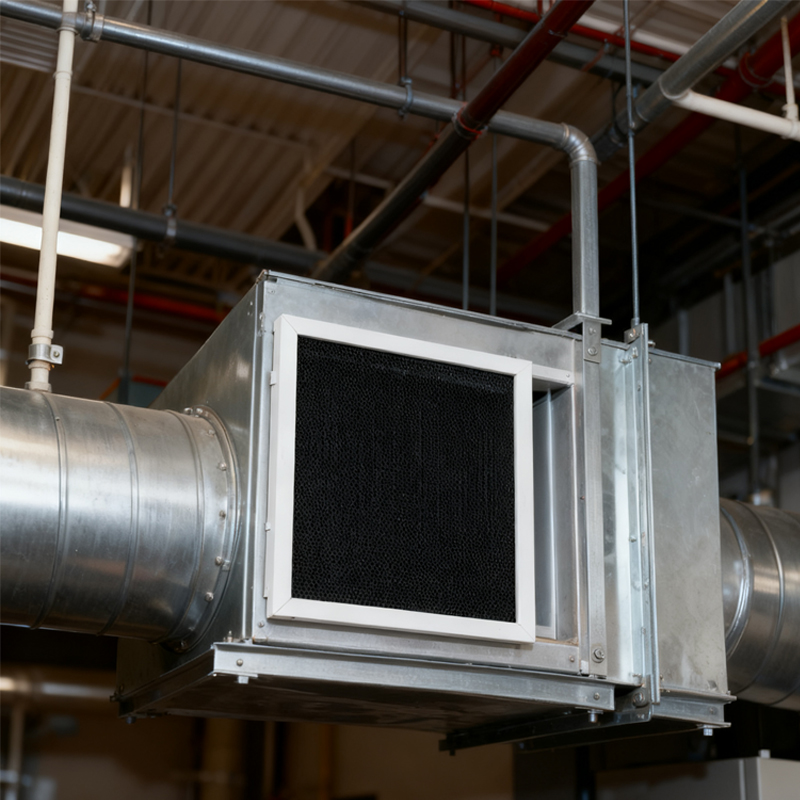
Odors, VOCs, and invisible air pollutants are often the hardest problems to solve in air purification-because trapping them is not the same as eliminating them. Many traditional filters simply absorb contaminants until they become saturated, after which performance drops sharply. This is where catalyst filters change the rules. Instead of relying on passive adsorption alone, a catalyst filter actively triggers chemical reactions that break odor-causing molecules into more stable, harmless compounds, delivering cleaner air with greater consistency.
In this article, we’ll explain what a catalyst filter is, how it works, the different types available, and where it is used, with a real-world product example to show how modern composite catalyst filter technology is applied for effective odor removal.
A catalyst filter is a type of filter that not only captures pollutants but also helps convert certain gases into less harmful substances. Instead of relying only on physical trapping, it uses a catalyst to trigger chemical reactions that break down odor-causing molecules, VOCs, or other reactive gases as air passes through.
In air purification, this matters because many of the worst air problems are gas-phase. Smells, VOCs, and formaldehyde don’t behave like dust, so simple particle filters won’t solve them. A catalyst filter is often used as a dedicated stage for these molecules, sometimes as part of a composite pack, so it can keep performance more consistent in the right conditions.
In exhaust treatment, the idea shifts toward conversion. The goal is to reduce reactive or harmful gases during airflow, not just collect them and hope the media lasts. You’ll see catalyst filters used where the air stream is controlled enough to support catalytic action.
A catalyst filter has two core parts: a substrate and a catalyst layer. The substrate is the physical structure air flows through-often a honeycomb, foam, mesh/net, or fiber/pleated form-designed to expose a large surface area while keeping airflow stable. On top of it sits the catalyst layer, typically noble metals or metal oxides, applied as a thin coating; a washcoat/binder helps it stick and stay evenly distributed during operation. Some designs add extra layers like activated carbon, frames, or seals to prevent bypass, but the basic idea stays the same: a strong flow path plus an active surface where pollutants can react.
A catalyst filter works because polluted air contacts an active catalytic surface, where certain gas molecules react instead of only being trapped. In many oxidation-based designs, odor compounds, formaldehyde, and VOCs are converted into more harmless products-most commonly CO₂ and H₂O-as they pass through the catalyst-coated media. This is what separates catalytic filters from adsorption-only media: adsorbents store pollutants and gradually saturate, while catalytic action aims to convert part of the pollutant load and keep removal more stable when conditions are right.
In real systems, performance depends strongly on operating conditions. Temperature affects reaction speed, oxygen level influences oxidation potential, and humidity can compete for active surface sites. Residence time and air velocity determine how long pollutants stay in contact with the catalyst, while pressure drop reflects the trade-off between contact efficiency and energy cost. Rioyee positions its BESIN composite catalyst filter for room-temperature air purification, where these factors are balanced for practical, stable odor control.
Catalyst filters come in a few “families.” We usually group them by what they remove, what the catalyst is, and how the filter is built. Those three angles help buyers pick the right option fast.
Some catalyst filters are tuned for one main problem. Others handle mixed air streams.
Odor removal catalyst filters
They focus on smell-causing molecules. It’s common in indoor air and process air.
Formaldehyde catalyst filters
They target HCHO in ventilation and purification setups.
VOCs catalyst filters
They handle common solvent-type gases in commercial or industrial air.
Multi-pollutant catalyst filters
They aim at blended streams. Odor + VOCs is a typical combo.
Quick “pick by problem” table
| Your main issue | Best-fit type you’ll see most |
|---|---|
| Smells and nuisance gases | Odor removal catalyst filter |
| Formaldehyde concern | Formaldehyde catalyst filter |
| Solvent-like gases | VOCs catalyst filter |
| Mixed indoor/industrial stream | Multi-pollutant catalyst filter |
The catalyst itself changes performance, cost, and tolerance. Two common buckets show up across suppliers.
Noble-metal catalyst filters
They use precious metals. They often deliver high activity. Cost tends to be higher.
Metal-oxide catalyst filters
They often cost less. Results depend more on conditions, especially temperature and humidity.
Chemistry snapshot
| Chemistry type | What people like | What they watch out for |
|---|---|---|
| Noble metal | Strong activity, fast conversion | Higher price, poisoning risk in harsh streams |
| Metal oxide | Cost-effective, practical for many uses | Performance varies more by operating conditions |
Structure decides airflow, surface contact, and pressure drop. It also affects how easy it is to fit the filter into a system.
They use channel structures. Air stays orderly. Contact stays predictable.
Nickel foam / metal foam catalytic filters
They use porous metal foam. Surface area can be high. Pressure drop can rise faster.
Mesh/net catalytic filters
They use net-like supports. They’re light and flexible for certain frames.
They combine layers or materials in one element. It can pair adsorption media and catalytic surfaces in a single design.
Structure comparison
| Form | What it’s good at | Typical trade-off |
|---|---|---|
| Honeycomb | Stable flow, consistent contact | Size and geometry constraints |
| Metal foam | High surface exposure | Higher resistance in some builds |
| Mesh/net | Lightweight, flexible integration | Lower depth, limited capacity |
| Composite | Multi-function in one element | Design complexity, more variables |
Catalyst filters are widely used in indoor air purification systems where gas-phase pollutants are the main concern. They are commonly installed in room air purifiers and ventilation units to address odors, formaldehyde, and VOCs that particle filters cannot remove effectively. In these settings, the filter works at room temperature and focuses on converting nuisance gases into more stable compounds, helping maintain consistent air quality in residential, commercial, and public spaces.
In specialized and industrial environments, catalyst filters are applied to exhaust gas treatment for low-to-moderate temperature air streams. Typical examples include process exhaust from manufacturing areas, laboratories, and enclosed production zones where odor and VOC control is required without high-temperature incineration. They are also used in food processing facilities, where odor control is critical. These air streams often contain grease or aerosols, so catalyst filters are usually protected by upstream filtration to prevent surface fouling and maintain performance.
Catalyst filters can operate as a standalone treatment stage when the incoming air is relatively clean and free of dust or oil mist. In more demanding systems, they are paired with prefilters to remove particles and aerosols before air reaches the catalytic surface. Placement matters: installing the catalyst filter too far upstream increases contamination risk, while proper downstream positioning improves stability and service life. System layout directly affects contact time, pressure drop, and overall conversion efficiency.
Catalyst filters deliver faster and more noticeable air quality improvement because they target gas-phase pollutants directly. Odor-causing molecules, VOCs, and other reactive compounds are reduced through catalytic reactions rather than only being stored in filter media. This makes them especially effective in environments where smells or chemical traces are the primary concern.
Unlike adsorption-only filters that gradually lose efficiency as they fill up, catalyst filters follow a dual adsorption and decomposition approach when conditions allow. Pollutants first contact the surface, then part of the load is chemically converted. This helps slow the performance drop associated with saturation and supports more stable removal over time in matched applications.
From an operational perspective, catalyst filters can offer lower secondary-pollution risk, since fewer captured gases remain stored in a saturated state. Many designs use modular or replaceable elements, making system integration and servicing simpler. Actual benefits depend on system design and operating conditions, but in the right setup, catalyst filters improve reliability without adding unnecessary complexity.


